Children grow quickly. Their belongings do not always need to disappear with them.
A jumper can be too small after only a few months. A favourite toy can suddenly be forgotten. Baby equipment that felt essential can become unnecessary almost overnight.
Before long, wardrobes, drawers, toy boxes and cupboards are full of perfectly usable things that no longer fit the stage your family is in now.
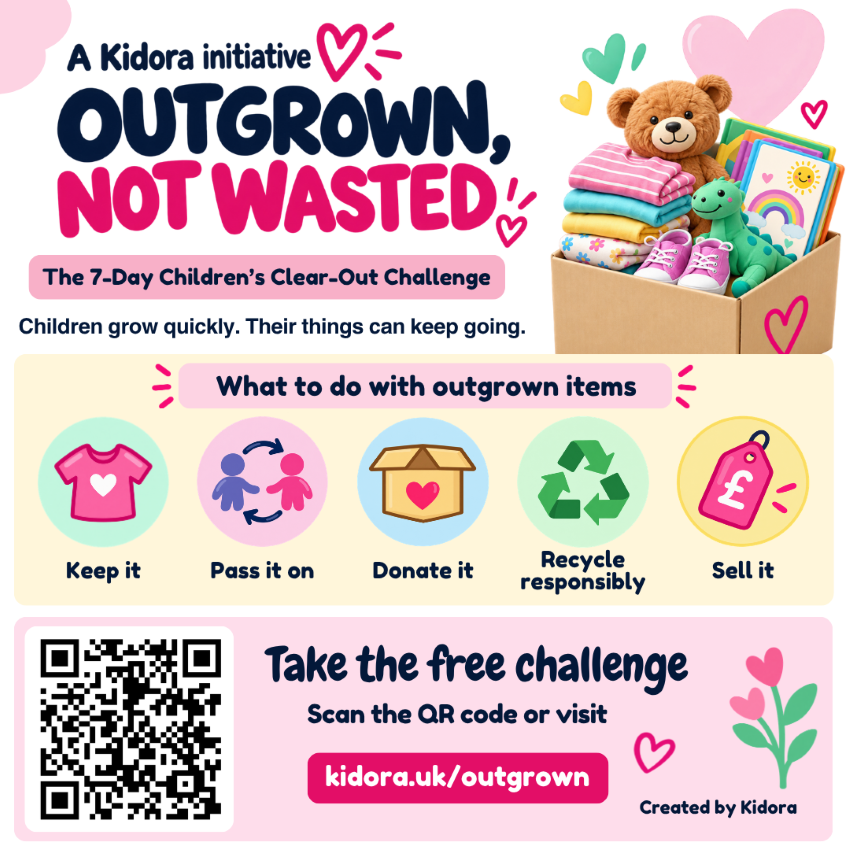
That is the idea behind Kidora’s free Outgrown, Not Wasted 7-Day Children’s Clear-Out Challenge: tackle one category each day, then give every item one of five next steps.
Keep it. Pass it on. Donate it. Recycle it responsibly. Sell it.
Day 1: Clothes
Start with wardrobes, drawers, coats and seasonal clothing.
Children move through sizes quickly, which means perfectly good clothes can become redundant long before they are worn out.
Keep sentimental pieces or clothes that will genuinely be used again. Pass good-quality items to younger siblings, relatives or friends. Donate clothes another family could use. Sell better-quality pieces or bundles if they still have value.
Anything too damaged for reuse should go through an appropriate textile recycling route where one is available.
Day 2: Toys
Toy boxes have an impressive ability to fill themselves.
Look for toys your child has clearly outgrown, duplicates and things that have not been touched for months.
If something clearly belongs to an earlier stage, this might be its chance to make another child happy.
Good toys can be passed on, donated or sold. Anything broken, incomplete or unsafe should not simply be handed to another family.
If your child is old enough, involve them. Asking, “Do you think another child would enjoy this now?” can feel very different from saying, “We are getting rid of your toys.”
It can turn a clear-out into a conversation about sharing, value and looking after the things we own.
Day 3: Books
Children’s books can have several lives.
A board book an older child has finished with might be exactly what a toddler in another family needs.
Keep genuine favourites, pass younger books to relatives or friends, donate suitable books where they are wanted, or sell collections and popular titles.
You may even rediscover a forgotten book before buying another one.
Day 4: Baby Equipment
Baby equipment can be one of the most valuable areas to check because children move through stages so quickly.
Before passing on, donating or selling baby equipment, check its condition, whether all parts are present and whether there are any relevant product safety warnings or recalls.
Some items may not be suitable for reuse depending on their age, history, condition or current safety guidance.
A useful rule is simple: if you would not feel comfortable using the item for your own child today, do not simply pass the problem to another family.
Reuse should always be safe reuse.
Day 5: Shoes and Accessories
Shoes, hats, gloves, bags and accessories often disappear into drawers long after children have outgrown them.
Try shoes on if you are unsure about sizing and check school bags, backpacks and seasonal accessories too.
You may discover things that still fit and save yourself an unnecessary purchase.
Anything genuinely outgrown can then be passed on, donated, sold or recycled appropriately depending on its condition.
Day 6: Larger Items
Now tackle the things taking up the most space.
Bikes, scooters, outdoor toys, furniture and larger children’s items can remain unused simply because dealing with them feels like a bigger job.
Ask yourself one question: will our family realistically use this again?
If the answer is no, decide its next step.
Larger items can be especially useful to another family because replacing them new can be expensive. They can also be worthwhile things to sell if they are still in good condition.
Check safety, condition, missing parts and any relevant recalls before passing something on.
Day 7: Give Everything Its Next Life
This is the day that makes the previous six worthwhile.
You now have a collection of things your children no longer need. The temptation is to put everything into bags and move those bags into another cupboard.
Do not stop there.
Keep sentimental or genuinely useful things. Pass items to people who can use them. Donate good-condition belongings where they are wanted. Recycle things that have reached the end of their useful life. Sell suitable items that still hold value.
This is the heart of Outgrown, Not Wasted: something no longer being useful to your family does not automatically mean it has become waste.
When is the best time to clear out?
There does not need to be a perfect moment.
A children’s clear-out can be useful before birthdays, Christmas, a new school term, a growth spurt, moving house or whenever another wave of clothes, toys and equipment is about to arrive.
Doing it before buying more can also change the way you spend.
You may rediscover toys that were forgotten, find clothes bought ahead in the next size or realise your child already owns something similar to what you were about to buy.
And if you sell a few suitable items, you may put some money back into the household at the same time.
That is why Outgrown, Not Wasted is designed around decisions rather than simply decluttering. The aim is not a perfectly minimalist home. Family life rarely works like that.
The aim is to make sure useful things do not become waste simply because deciding what to do with them felt too difficult.
Start with one drawer
You do not need a free weekend, a skip or a perfectly organised house.
Start with one drawer. Tomorrow, do the toy box. Then the bookshelf.
Seven small decisions are easier than one enormous clear-out.
By the end of the week, you may have more space, fewer forgotten belongings, some money back in the household and useful things ready to begin their next life somewhere else.
And perhaps most importantly, the next time your child grows out of something, the question changes from “Where can I put this?” to “What is the best next life for it?”
About Kidora
Kidora is a UK family platform founded by Karolina Gudes, a mum of two from North Wales.
It brings together three areas for families: a parent-to-parent marketplace for preloved baby and children’s items, a Parent Hub with practical family content, and Family Places, a directory of more than 6,500 places to visit across the UK.
The Outgrown, Not Wasted campaign grew from the same idea behind Kidora: children constantly move on to the next size, stage and interest, while many of the things they leave behind still have useful life and value.
If selling is the right next step, parents can use Kidora’s specialist marketplace for preloved baby and children’s items. Sellers pay no seller fees, so they keep 100% of the item price, with local collection and nationwide delivery available.
Kidora is also available on iOS and Android, making it easy for parents to browse, buy and list preloved baby and children’s items from their phone.
The free Outgrown, Not Wasted 7-Day Children’s Clear-Out Challenge also includes a printable family checklist and free resources for schools, nurseries, PTAs and community organisations.