The Parent Source – A simple guide to finding the right professional support for your child and family
When your child is struggling, knowing where to turn can sometimes feel like the hardest part.
Maybe they have become increasingly anxious, are finding school difficult, struggling with friendships or behaviour, or becoming overwhelmed by everyday situations.
Perhaps you have concerns about their speech, learning, sensory needs or emotional wellbeing. Or maybe your child already has a diagnosis such as autism or ADHD and you are looking for some additional support.
For many parents, the difficult part is not recognising that their child needs help.
It is knowing what kind of help they need — and who might be best placed to provide it.
With psychologists, counsellors, occupational therapists, speech and language therapists, educational professionals and many other specialists available, it can quickly become confusing.
The good news is that you do not need to have everything figured out before you start looking for support.
You don’t need to wait for a diagnosis
Your child does not always need a formal diagnosis before you explore professional support.
Sometimes you simply know that something is not quite right.
Your child may be anxious about school, struggling to regulate their emotions, finding friendships difficult or becoming overwhelmed by sensory experiences.
They may be having difficulties with learning, communication, confidence or behaviour.
Could your child benefit from some extra support?
Children and young people may need help for many different reasons.
You might consider exploring professional support if your child is struggling with:
✓ School anxiety, attendance or coping with school | ✓ Speech, language or communication |
✓ Anxiety, worries or low mood | ✓ Confidence or self-esteem |
✓ Emotional regulation or behaviour | ✓ Friendships or relationships |
✓ Autism, ADHD or other neurodevelopmental needs | ✓ Learning or educational difficulties |
✓ Sensory differences | ✓ Sleep or routines |
✓ Family changes or separation | ✓ Trauma or difficult life experiences |
✓ Parenting challenges | ✓ Concerns about their development |
Support might only be needed for a short period, while other children and families may benefit from longer-term help.
There is no single answer that is right for every child.
Who might be able to help?
This is where many parents understandably become confused.
Different professionals can sometimes help with similar difficulties, and the right choice will depend on what is happening for your child.
Here are some of the professionals you might come across.
Psychologists
Psychologists may support children and young people experiencing emotional, behavioural, developmental or psychological difficulties.
Depending on their professional role, they may offer psychological assessment, therapy or other forms of support.
Counsellors and Psychotherapists
Counsellors and psychotherapists may support children and young people with anxiety, low mood, confidence, relationships, trauma, emotional difficulties and challenging life experiences.
Occupational Therapists
Paediatric occupational therapists may support children with areas such as:
- sensory processing
- emotional regulation
- motor skills
- independence
- daily routines
- participation at home or school.
Speech and Language Therapists
Speech and language therapists may support children who have difficulties with:
- speech
- language
- communication
- understanding
- interaction
- social communication.
Educational Psychologists and Educational Professionals
Some children need additional support with learning or accessing education.
Educational psychologists and other educational professionals may support areas such as learning difficulties, dyslexia, school avoidance, additional learning needs or challenges affecting a child’s experience at school.
Family and Parenting Professionals
Sometimes it is not only the child who would benefit from support.
Parents may want guidance around behaviour, communication, relationships, routines, family changes or supporting a child with additional needs.
Family-focused professionals can help parents understand what may be happening and explore practical ways forward.
Start with the problem — not the professional
You do not need to know whether your child needs an occupational therapist, psychologist or counsellor before you begin looking.
Instead, think about what you are noticing.
For example:
“My child becomes extremely overwhelmed after school.”
“My teenager’s anxiety is making it difficult for them to attend school.”
“My child is struggling socially and I don’t know why.”
“Behaviour at home has become really difficult and we need some guidance.”
“I’m worried about my child’s speech and communication.”
Starting with the difficulty rather than the professional title can make finding the right support much easier.
Before choosing a professional, ask these questions
It is completely reasonable to contact a professional and ask questions before deciding whether they are right for your family.
Consider asking:
✓ Are they appropriately qualified or registered?
Different professions have different registration requirements, so check what is relevant for the professional you are considering.
✓ Do they regularly work with children my child’s age?
Someone may be highly qualified but may not specialise in the age group or difficulty your child is experiencing.
✓ Do they have experience with this particular difficulty?
Ask about their experience supporting children with similar needs.
✓ What happens at the first appointment?
Some professionals work directly with the child, while others may initially meet with parents or involve the wider family.
✓ Are appointments online or face-to-face?
Depending on the service and your child’s needs, either option may be appropriate.
✓ How long is the waiting list?
Waiting times can vary considerably between professionals.
✓ What are the fees?
Make sure you understand the cost before beginning support.
✓ Does this person feel like a good fit for our family?
Qualifications matter, but so does the relationship.
Children and young people are often more able to engage when they feel comfortable, listened to and understood.
What about online support?
Online professional support has given families much more choice.
In the past, parents were often limited to professionals within travelling distance of where they lived.
Now, depending on the type of support required, families may be able to work with professionals based elsewhere in the UK or further afield.
This can be particularly useful if your child needs support in a very specific area.
Some assessments and therapies will still need to take place face-to-face.
However, services such as counselling, parenting support, tutoring, consultation and some forms of professional guidance may be available online.
Not sure where to begin?
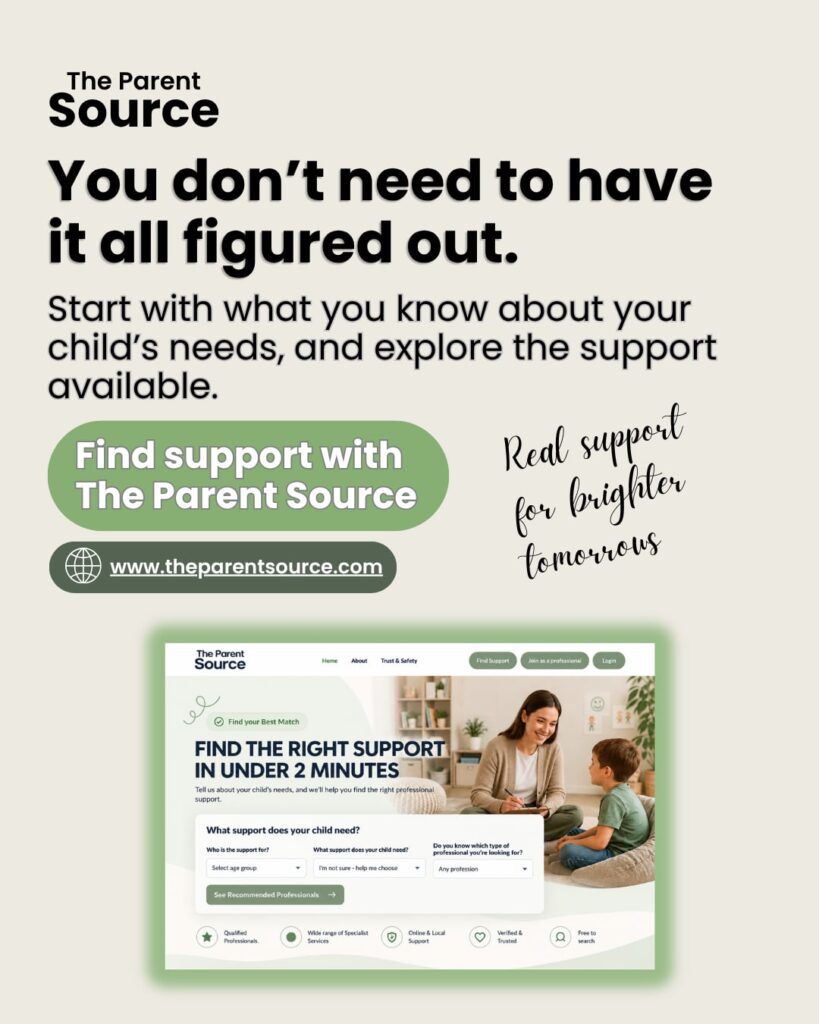
This is exactly why The Parent Source was created.
The Parent Source is an online platform helping parents and carers find professionals who support children, young people and families.
Instead of searching through numerous websites trying to work out who provides what, parents can explore different types of support in one place.
Families may be able to find professionals supporting areas including:
Children’s mental health
Anxiety and emotional wellbeing
Autism and ADHD
SEND
Occupational therapy
Speech and language
Learning and education
School difficulties
Parenting
Family relationships
Behaviour
Sensory needs
Parents can:
✓ Browse professional profiles
✓ Explore different specialisms
✓ Find online or face-to-face services
✓ Read about professionals’ experience
✓ Contact practitioners directly
✓ Explore support at their own pace
The Parent Source is free for parents and carers to use.
The platform does not provide treatment, diagnoses or clinical recommendations itself.
Its purpose is to make it easier for families to discover professional support and connect directly with independent practitioners.
Professionals provide information about their qualifications, professional background and relevant registrations as part of the joining process, and The Parent Source carries out checks as part of this process. Parents should still ask any questions that are important to them before beginning work with a practitioner.
You don’t have to have all the answers
Perhaps the most important thing to remember is this:
You do not need to know exactly what your child needs before you ask for help.
You might not know whether counselling, occupational therapy, educational support or something completely different would be best.
You may simply know:
“My child is struggling, and I would like to understand what support is available.”
That is enough of a starting point.
Sometimes reading about different professionals can help.
Sometimes one conversation with a practitioner can point you in the right direction.
And sometimes simply finding someone who understands what your family is experiencing can make the next step feel much easier.
Finding support should feel simpler
Parents already spend huge amounts of time searching for information, making phone calls and trying to work out where to go next.
Finding professional support should not add another layer of stress.
The Parent Source aims to give families a clearer starting point by bringing professionals supporting children, young people and families together in one accessible place.
FIND SUPPORT FOR YOUR FAMILY
Free to use for parents and carers
Browse qualified professionals supporting children, young people and families.