There is a particular kind of afternoon that every parent of a small child knows. It is too wet for the park, everyone has had enough of the telly, and you have perhaps twenty minutes of goodwill left before somebody melts down. That is exactly the moment this game was made for.
It is called the Two-Map Adventure. You print two pages, sit on opposite sides of the kitchen table and go on a journey together through a tiny village, without leaving your chairs. No batteries, no screens, no winners: just a map, a secret route and a lot of talking.
How it works
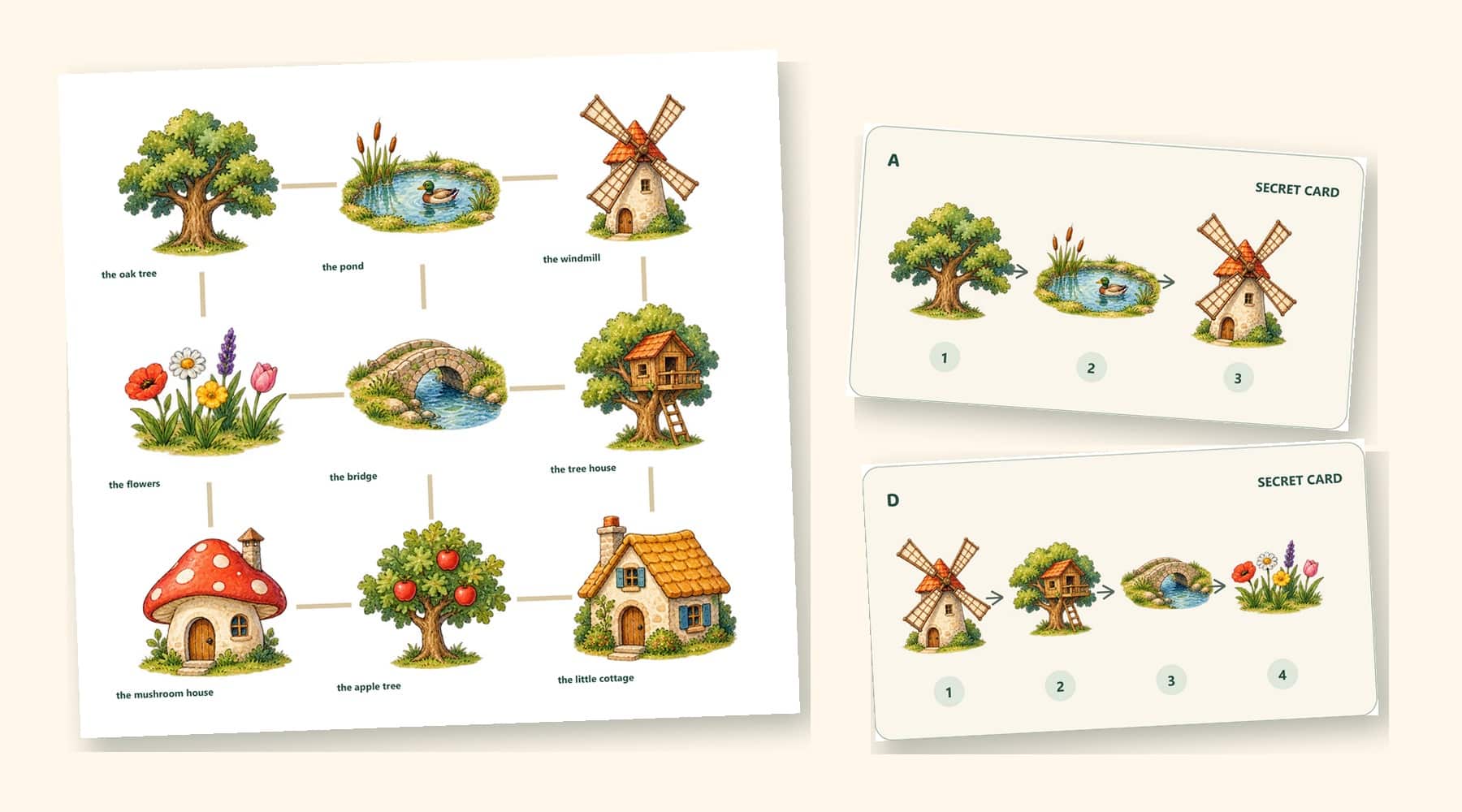
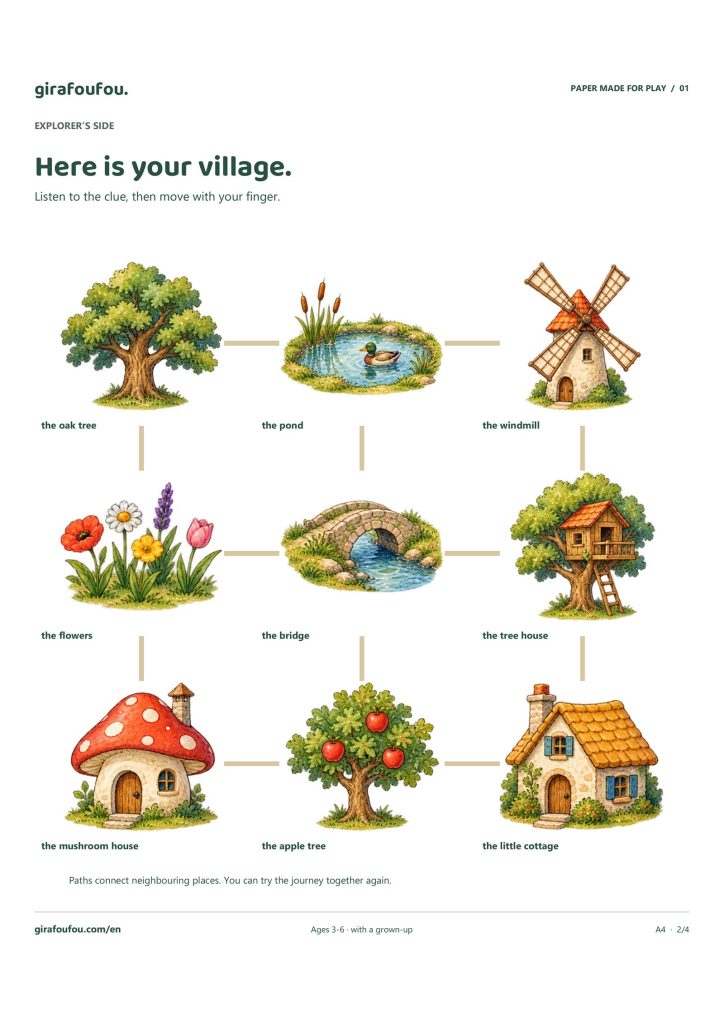
One of you is the explorer. The explorer has the village map: nine little places joined by paths. There is an oak tree, a pond with a duck, a windmill, a patch of flowers, a stone bridge, a tree house, a mushroom house, an apple tree and a little cottage. Each place sits next to its neighbours, and the paths show which ones you can walk between.
The other is the guide. The guide has a page of six secret cards, labelled A to F. Each card shows a short route through the village, three or four stops long, read from left to right. The first picture is the starting point.
The guide keeps their card hidden and describes each stop in order. The explorer listens, finds the place on the map and moves their finger along the path to get there. When the journey is finished, the guide reveals the card and you trace the route together to see whether you ended up in the same place.
Then you swap. This is the part children love most: being the one who knows the secret.
Setting up (about two minutes)
You can download the free Two-Map Adventure printable in A4 or US Letter. There is no account to create and no email address to give. The pack has four pages, but you only need to print two of them:
- Page 2, the explorer’s village map
- Page 3, the guide’s six secret route cards
Print single-sided at actual size. Give the village to your child, choose a secret card for yourself, and you are ready. Cutting the cards apart is optional; you can simply cover the others with your hand.
Playing your first journey
Start with card A, which is only three stops long. Rather than naming the first place, describe it: “A big tree with lots of leaves.” Let your child search the map, point and say what they have found. Then describe the next stop, and the next.
A few things make the first game go smoothly:
- Start with two places and keep the card visible. For a three-year-old, simply going from one picture to the next along a path is already a small achievement.
- Naming the place is fine if it helps. The point is to have fun together, not to set a riddle nobody can solve.
- If a clue does not land, try another one. “It’s yellow” might not work, but “it has a roof and a little chimney” might.
- Remember there is no score and no race. Taking a wrong turn and finding your way back is part of the adventure.
Once your child is confident, hide the card and try three stops, then four. Cards D, E and F have four stops each.
Swapping roles
When your child becomes the guide, something lovely happens. They have to look at a picture and find words for it that someone else can understand. You will hear descriptions you would never have thought of. A windmill might become “the house with the big spinning cross”. The apple tree might be “the one with the red balls in it”.
Play along. Go to the wrong place now and then so they can correct you. Ask “Is it near the water?” or “Do I need to cross the bridge?” Children of four and five often enjoy being the one in charge far more than the one following instructions, and it gives them a real reason to describe, compare and explain.
Inventing a new adventure
The last page of the pack is an optional extra. A grown-up cuts out the nine place cards, and together you lay out your own route, choosing places that are neighbours on the map. Your child can then guide you along a journey they designed themselves, which tends to be a source of enormous pride.
If you have older children at home, they make excellent guides for younger brothers and sisters. Giving clues to a three-year-old is a surprisingly good exercise in patience and clear explanation, and it can buy a parent ten minutes with a cup of tea.
Why a paper game?
Small children learn a great deal through conversation: listening carefully, putting things in order, using words like “next to”, “across” and “after”. This game keeps all of that, while being short enough for a small attention span. One journey can be plenty.
It also works anywhere you have a flat surface: the kitchen table, a café while you wait for lunch, the floor of a holiday cottage.
About Girafoufou
I’m Marcel, a dad in the south of France with a three-year-old daughter. I created Girafoufou, a calm learning game for children aged 3 to 6 in British English, with numbers, letter sounds and puzzles, no adverts, and a giraffe who goes off for a nap after a while so the screen switches off by itself. Paper activities like this one are our way of making sure the fun carries on once the tablet is put away.
The Two-Map Adventure is free to print and share. If you try it, I would love to hear which descriptions your little explorer comes up with.
Illustrations: Girafoufou, created with the help of AI.